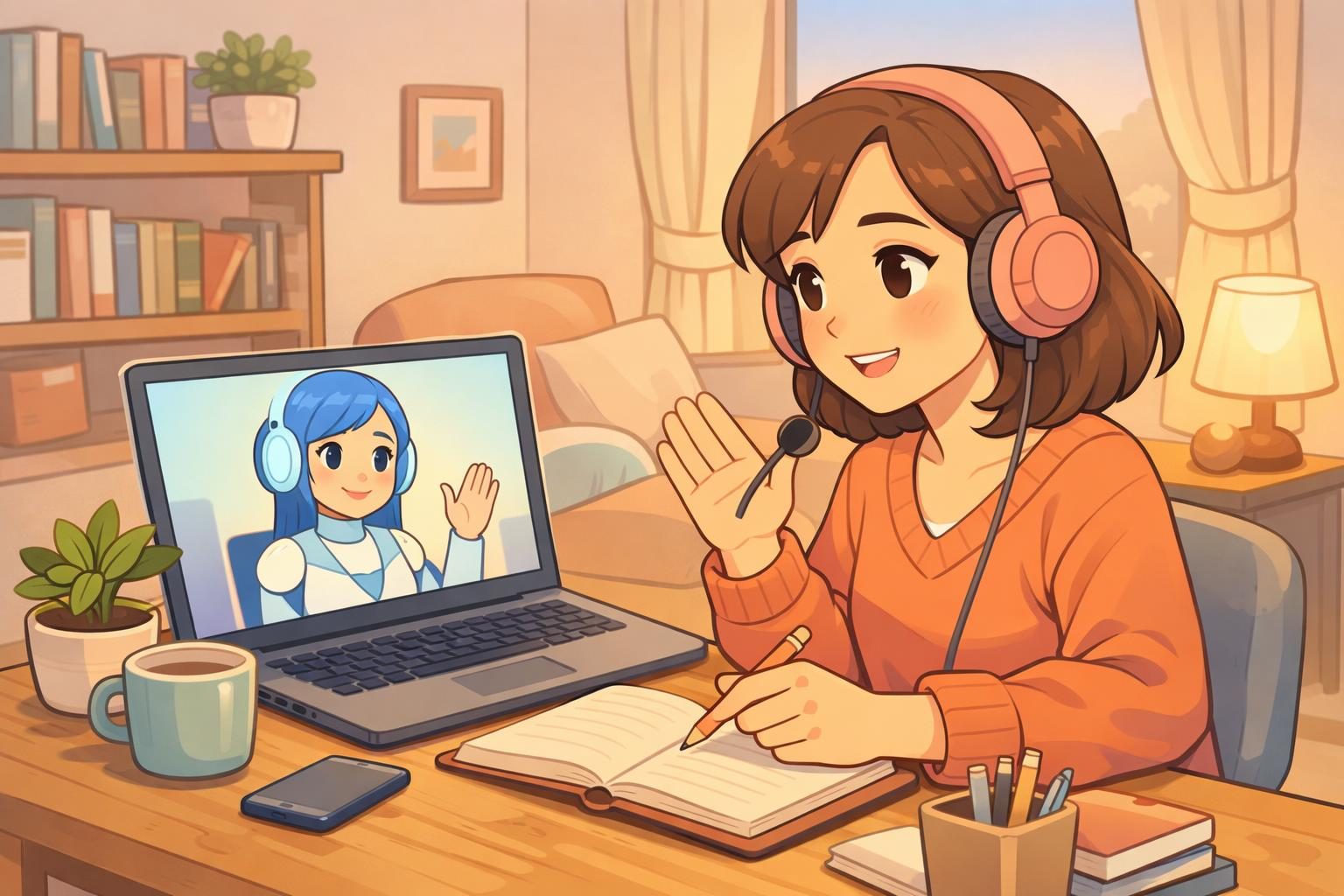
If you are preparing for IELTS, the internet will happily drown you in sample answers, band score hacks, and random strangers telling you to “just speak naturally.” That advice is not useless, but a lot of it falls apart the second you sit down alone at home and try to practice out loud.
Here is the more useful truth: IELTS speaking practice at home works best when you stop treating it like content consumption and start treating it like rehearsal. In 2026, that matters even more because AI tools are finally good at giving immediate feedback on fluency, pronunciation, and hesitation patterns. Pearson’s 2026 language teaching trend report argues that AI is moving from novelty to dependable support for speaking feedback, which is exactly why more learners are building solo speaking routines instead of waiting around for a tutor slot or a language partner to answer messages.
That does not mean you should trust every app claiming it can magically predict your band score. That is where people get themselves in trouble. The best use of AI for IELTS is practice, repetition, and feedback, not fake certainty. Use the official IELTS sample questions and the official guide to understanding IELTS scores as your anchor, then use AI to do the reps.
Why home practice is suddenly a lot more effective
For years, home speaking practice had one big weakness: you could talk to yourself, but you could not get reliable feedback fast enough to improve. That gap is shrinking. A 2025 open-access study in Humanities and Social Sciences Communications found that AI-powered mobile speaking support improved speaking performance over a 10-week period. Another 2025 study in the same journal, this randomized controlled trial on AI-driven speech recognition, reported lower anxiety alongside stronger language outcomes. That last part matters a lot for IELTS because plenty of test takers know the language well enough, then freeze the minute they have to answer under pressure.
That is also why general speaking confidence work still matters. If your main problem is blanking when you open your mouth, not lack of knowledge, you should read why AI conversation partners reduce speaking anxiety. And if you keep waiting for perfect conditions before you practice, start with a shorter solo routine like the one in this guide to practicing a language alone.
A simple IELTS speaking routine you can do at home
You do not need a two-hour study block. You need a repeatable structure. A solid home session can be 20 to 30 minutes:
- Warm up for 3 minutes. Answer easy personal questions out loud: where you live, what you do, what you studied, what you did yesterday. The goal is to get your mouth moving before you hit harder prompts.
- Do one Part 1 round. Pick a familiar topic like work, hometown, hobbies, or food. Answer 6 to 8 short questions and keep your responses natural, not memorized.
- Do one Part 2 prompt. Set a timer, take one minute to prepare, then speak for up to two minutes. This is where many people realize their problem is not vocabulary, it is structure.
- Do one Part 3 discussion. Push beyond personal answers. Explain opinions, compare ideas, and give reasons. That is where stronger band scores usually separate themselves from merely “good enough” English.
- Review one recording. Listen back once and look for three things only: where you hesitated, where you repeated yourself, and where your pronunciation became unclear.
If you want a practical way to rehearse those answers, use an AI conversation partner that can role-play an examiner, keep the exchange moving, and give feedback after each turn. That is a lot more useful than memorizing polished sample answers you will never reproduce naturally in the test.
What AI feedback is actually good for, and what it is bad for
Good AI feedback helps you spot patterns. Maybe you pause too long before abstract questions. Maybe your grammar is fine, but your answers stay too short. Maybe your pronunciation drops when you get nervous. That is useful because you can fix patterns with repetition.
Bad AI feedback pretends to be an oracle. If a tool spits out a precise band score after one answer and acts like that number is gospel, be skeptical. IELTS scoring is based on multiple dimensions, including fluency and coherence, lexical resource, grammatical range and accuracy, and pronunciation. No single auto-score should be treated as the truth. The official descriptors matter more than some flashy gauge trying to scare you into a subscription.
That is one reason people comparing speaking tools in 2026 should look beyond marketing. This comparison of AI speaking practice apps breaks down the difference between open conversation practice, pronunciation-heavy tools, and more structured lesson apps. For IELTS prep, you want something that lets you answer unpredictable prompts, not just repeat canned sentences.
How to make your answers sound stronger without sounding scripted
The trap is memorization. Test takers panic, find “band 8 sample answers,” and start trying to sound like a robot with a thesaurus. Examiners can smell that from a mile away.
A better approach is to practice answer shapes, not answer scripts. For example:
- Start with a direct answer.
- Add one concrete reason.
- Give a short example or comparison.
- Stop before you ramble yourself into a ditch.
That structure sounds more natural, and it holds up even when the prompt changes. If you have an important English conversation coming up before test day, the same logic applies. A last-minute speaking warm-up is often better than cramming more passive input.
The smartest way to use Talkio for IELTS speaking practice at home
Talkio is strongest when you use it as a rehearsal engine. Take official question types, turn them into live prompts, answer out loud, and repeat until your responses feel flexible instead of fragile. You can practice follow-up questions, switch topics quickly, and get pronunciation feedback without needing another person in the room. That makes it easier to build consistency, which is what most learners are actually missing.
If you are serious about improving, run the same routine three or four times a week. Record yourself. Compare older answers to newer ones. Notice whether you recover faster after a difficult question. That is real progress. Not a shiny fake score, not a saved PDF full of model answers, real speaking progress.
So if you are wondering how to do IELTS speaking practice at home in 2026, here is the answer: use official question formats, practice out loud on a timer, get immediate feedback, and do enough repetitions that speaking under pressure starts to feel normal. Boring? Maybe. Effective? Yeah, absolutely.