
You can replay a podcast ten times, recognize half the words, and still freeze when a real person asks you a simple question. That does not mean you are “bad at listening.” It usually means you have been training the wrong version of listening.
Passive listening builds familiarity. Real-time conversation builds survival speed: the ability to hear, predict, respond, repair misunderstandings, and keep going. Those are different skills.
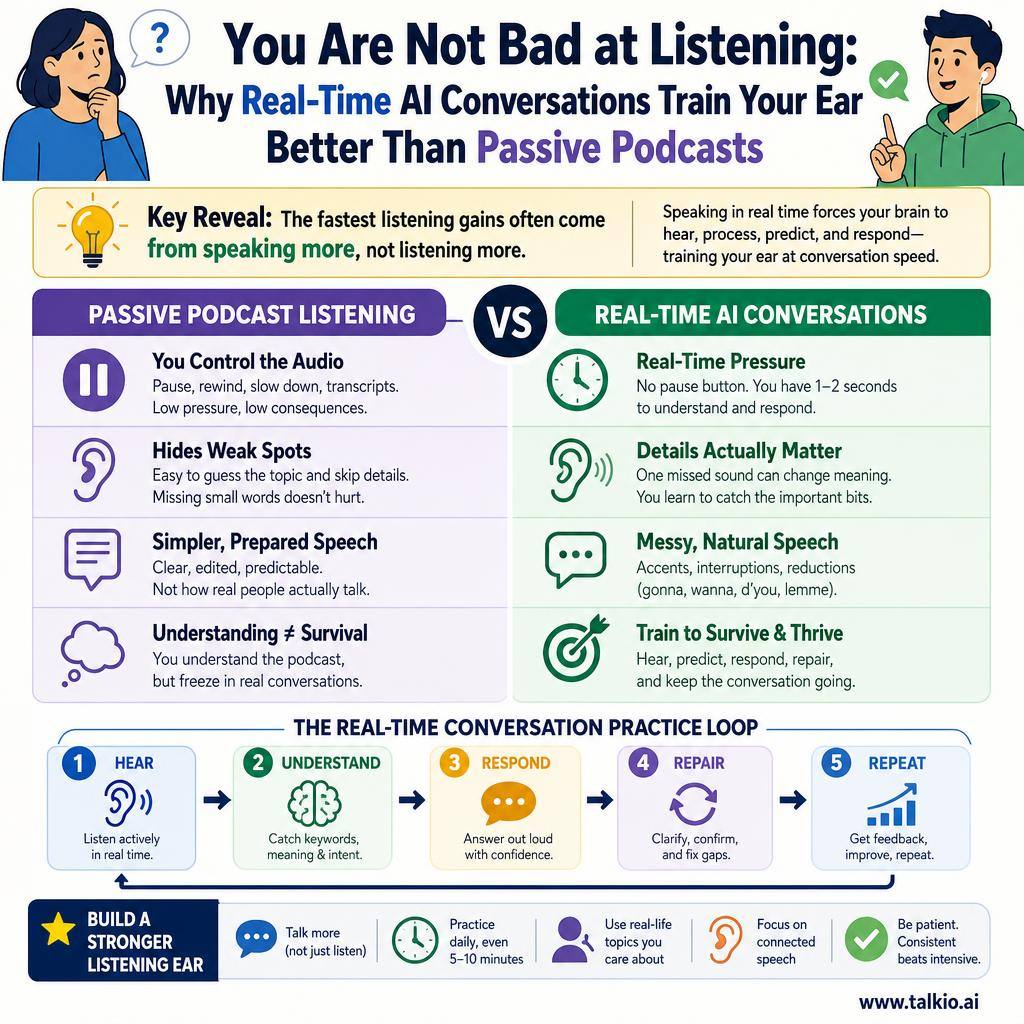
Here is the useful reveal we will come back to near the end: the fastest listening gains often come from speaking more, not listening more. That sounds backwards, but once you understand how conversation trains the ear, it makes perfect sense.
Why Podcasts Feel Productive but Do Not Always Fix Real Listening
Podcasts, videos, and audiobooks are not useless. They expose you to rhythm, vocabulary, accents, and cultural references. The problem is that most learners use them as if “more audio” automatically becomes “better listening.” It does not.
The podcast trap
When you listen to a podcast, you usually control the difficulty:
- You can pause.
- You can rewind.
- You can slow the speed.
- You can use transcripts.
- You can let difficult parts pass without consequence.
In real conversation, none of that happens neatly. Someone says, “So what did you think of the meeting?” and you have one or two seconds to understand the question, choose your answer, and respond naturally. That pressure changes everything.
Passive listening hides your weak spots
When listening alone, you can often guess the general topic without understanding the details. In conversation, the details matter. If someone says, “I wouldn’t recommend that route,” missing one sound changes the meaning completely.
This is why learners often say, “I understand podcasts, but I cannot understand people.” What they usually mean is:
- “I understand prepared speech, but not messy speech.”
- “I understand when I know the topic, but not when the topic changes.”
- “I understand sentences, but not fast follow-up questions.”
- “I understand individual words, but not reductions like gonna, wanna, d’you, or lemme.”
If connected speech is one of your biggest pain points, read Talkio’s breakdown of how “What do you want to do?” becomes “Whaddaya wanna do?”. It explains why real speech often sounds nothing like your textbook.
Real-Time AI Conversation Trains the Ear Differently
Listening in conversation is not just receiving sound. It is a loop: hear, interpret, respond, adjust. AI conversation practice can recreate that loop without making you wait for a language partner or feel embarrassed in front of a native speaker.
What your brain has to do in a live exchange
In a real-time conversation, your brain is doing several jobs at once:
- Sound decoding: recognizing words through accent, speed, stress, and reductions.
- Meaning prediction: guessing what kind of answer is expected.
- Memory holding: keeping the question in your mind while planning your response.
- Turn-taking: knowing when to answer, interrupt politely, or ask for clarification.
- Repair: recovering when you missed something.
Passive podcasts mostly train the first two. Real-time conversations train all five.
Why AI tutors are useful for listening practice
An AI conversation partner can give you repeated exposure to the kind of listening that normally only happens in live situations. With a platform like Talkio, learners can speak with an AI tutor, receive feedback, and practice structured role-play scenarios across languages and dialects. The educational value is not that the AI “replaces” humans. It is that it gives you more safe, repeatable, targeted speaking-and-listening turns.
That matters because the biggest listening problem for many learners is not lack of knowledge. It is lack of interactive reps.
For a broader look at this shift, see Talkio’s article on why language training is moving toward AI conversations.

The Listening Skills Podcasts Rarely Train
Good listening is not one skill. It is a bundle of micro-skills. If you only train with passive audio, some of them stay weak for years.
1. Hearing questions under pressure
Questions are harder than statements because they demand action. You are not just understanding; you are preparing to answer.
Try this mini drill in your target language:
- Ask the AI tutor to ask you ten questions about your weekend.
- Answer each one in under five seconds.
- If you miss a question, say: “Could you ask that in a different way?”
- After the drill, ask for a list of the questions you misunderstood.
Useful prompt:
“Ask me quick follow-up questions about my weekend. Keep the pace natural. If I answer incorrectly, rephrase the question and tell me which word I probably missed.”
2. Understanding messy, natural phrasing
Textbook audio often sounds like this:
“Would you like to go to the restaurant this evening?”
Real speech may sound more like:
“D’you wanna grab food later?”
Both mean roughly the same thing. But learners who only train with clean audio may panic when real people use compressed phrases.
| Textbook version | Natural version | What to listen for |
|---|---|---|
| What are you going to do? | Whatcha gonna do? | Reduced “what are you” and “going to” |
| Did you eat yet? | Jeet yet? | Blended “did you” |
| I do not know. | I dunno. | Compressed negative phrase |
| Let me see. | Lemme see. | Blended consonants |
3. Repairing misunderstandings without switching languages
Many learners think good listening means never needing clarification. That is false. Strong speakers ask for clarification smoothly.
Practice these repair phrases:
- “Sorry, did you say Tuesday or Thursday?”
- “I caught the first part, but not the last part.”
- “Could you repeat the name of the place?”
- “Do you mean I should send it today?”
- “Let me check if I understood you correctly.”
This kind of repair practice is also useful for reducing speaking anxiety. Talkio has covered why AI conversation partners can reduce language anxiety, especially when learners need low-pressure repetition.
Why Speaking Practice Secretly Improves Listening
Here is the reveal: one of the best ways to improve listening is to produce the sounds, rhythms, and sentence patterns yourself.
When you speak, you build a stronger internal model of the language. You start noticing where stress falls, which syllables disappear, how grammar sounds in motion, and what kinds of answers naturally follow certain questions.
Your mouth teaches your ear
If you struggle to hear the difference between ship and sheep, repeating the words carefully can sharpen your perception. If you cannot hear English th, learning how to place your tongue often makes the sound easier to recognize in other people’s speech.
This is not just a classroom trick. Research on speech perception and production has long suggested that listening and speaking are deeply connected. For academic starting points, you can explore studies through Google Scholar or language education research in ERIC.
Talkio’s article on training vowel perception with minimal pairs like ship vs. sheep gives a practical example of how targeted speaking drills can support listening accuracy.
Listening improves when you predict better
Conversation is full of prediction. If someone says, “Do you have any plans for…” your brain expects a time phrase: tonight, the weekend, next summer. The better your speaking patterns are, the better your predictions become.
That is why learners who only consume content can still feel slow in conversation. They know many words, but they have not practiced enough turn-by-turn prediction.
A 20-Minute AI Listening Workout That Beats Another Podcast Episode
If you want to use AI conversation to train your ear, do not just “chat randomly.” Random conversation can help, but structured drills work faster. Use this 20-minute routine three or four times per week.
Step-by-step routine
-
Minute 0-3: Sound warm-up.
Ask for five tricky words or phrases in your target language. Repeat them, then ask for pronunciation feedback. -
Minute 3-7: Question burst.
Ask the AI tutor to ask short, natural questions quickly. Your goal is not perfect grammar. Your goal is fast understanding. -
Minute 7-12: Role-play with interruptions.
Practice a realistic scene: checking into a hotel, joining a meeting, ordering lunch, asking for directions, or handling a customer call. -
Minute 12-16: Clarification drill.
Ask the tutor to intentionally include one unclear detail. Practice asking follow-up questions. -
Minute 16-19: Replay and rephrase.
Ask for three sentences you misunderstood. Have them repeated in natural and slower versions. -
Minute 19-20: One takeaway.
Write or say one thing you heard better today: a sound, phrase, reduction, or grammar pattern.
Prompts you can copy
- Beginner: “Ask me simple questions about my day. Speak naturally but not too fast. Correct only the words I misunderstand.”
- Intermediate: “Role-play a café conversation with natural speed. Use follow-up questions and some common reductions.”
- Advanced: “Debate a workplace decision with me. Interrupt politely, challenge my points, and use idiomatic phrasing.”
- Travel: “Pretend I am asking for help at a train station. Include platform numbers, times, and one unexpected change.”
- Business English: “Run a short meeting simulation. Ask me to clarify deadlines, responsibilities, and next steps.”
If your goal is professional communication, you may also like Talkio’s guide on how to improve your Business English and sound more professional.
Passive Listening vs. AI Conversation: What Each One Is Best For
This is not a war between podcasts and AI. The smarter question is: what should each tool do in your study routine?
| Practice type | Best for | Weakness | How to use it well |
|---|---|---|---|
| Podcasts | Exposure, vocabulary, cultural topics, rhythm | No speaking pressure or repair practice | Listen for repeated phrases, then use them in conversation |
| Videos | Visual context, gestures, informal speech | Subtitles can become a crutch | Watch once without subtitles, once with subtitles, then summarize aloud |
| Transcripts | Checking missed words and grammar | Reading can replace listening | Use after listening, not before |
| AI conversation | Real-time response, clarification, pronunciation feedback, role-play | Needs active participation | Use structured prompts and track recurring misunderstandings |
The best mix for most learners
A strong weekly routine might look like this:
- 2 sessions of podcast or video listening for broad exposure.
- 3 sessions of AI conversation for interactive listening and speaking.
- 1 review session focused on the phrases, sounds, and questions you missed.
If you currently practice alone, this guide on how to practice speaking a language alone with AI warm-ups gives a practical way to begin without overthinking your routine.
How to Train for Different Accents and Real-World Speech
One hidden reason listening feels hard is accent mismatch. You study one variety of a language, then meet speakers from another region and feel like you are starting over.
English alone includes many major varieties, and Spanish, Arabic, French, Portuguese, German, and many other languages vary widely by region. Linguistic databases such as Ethnologue and Glottolog show just how diverse the world’s languages and dialects are.
Accent practice prompts
Use prompts like these to avoid training your ear on only one “standard” voice:
- “Give me a travel role-play using Mexican Spanish vocabulary and natural speed.”
- “Practice British English small talk with me, then explain any phrases that differ from American English.”
- “Use a formal workplace tone in French, then repeat the same ideas in a more casual style.”
- “Help me compare European Portuguese and Brazilian Portuguese pronunciation in short phrases.”
- “Ask me common customer service questions in English with a neutral international accent.”
For Spanish learners, Talkio’s guide to Spanish accents and dialects is a useful next step. If you are learning English for global communication, you may also want to compare practice options for American English and British English.
Do not chase every accent at once
A common mistake is trying to understand every regional variety immediately. Instead, use a layered approach:
- Choose your primary target: the accent or dialect you need most for work, study, travel, family, or exams.
- Build comfort there first: practice daily questions, common reductions, and role-play situations.
- Add contrast: compare the same phrase in another accent once or twice per week.
- Track surprises: keep a list of words that sound different across regions.
The Mistake That Keeps Learners Stuck: Listening Without Accountability
The uncomfortable truth is that many learners listen for hundreds of hours without ever checking what they actually understood. They feel productive because audio is playing. But the brain can drift, guess, and avoid hard details.
Real-time conversation adds accountability. If you misunderstand the question, your answer will show it. That can feel awkward, but it is exactly why it works.
A quick self-test
After your next listening session, ask yourself:
- Can I summarize the main idea aloud without switching languages?
- Can I repeat three exact phrases I heard?
- Can I answer follow-up questions about the audio?
- Can I use one new phrase in my own sentence?
- Can I identify one sound or reduction that confused me?
If the answer is mostly no, you did not fail. You just found the missing step: turning listening into interaction.
The “listen, speak, repair” loop
Use this simple framework:
- Listen: hear a short question, phrase, or scenario.
- Speak: respond immediately, even if imperfectly.
- Repair: ask for clarification, correction, or a slower repeat.
- Repeat: try again with the same pattern in a new situation.
This loop is especially helpful if you have reached the stage where you understand lessons but still cannot react quickly. Talkio calls this the fluency plateau, and it is explored in more detail in why intermediate learners stop improving and how AI speaking practice can break the loop.
What to Do This Week If You Want Better Listening
Do not delete your podcasts. Change their job. Let them feed your vocabulary and cultural understanding. Then use real-time conversation to test whether your ear can survive actual interaction.
Try this seven-day plan:
- Day 1: Listen to a short podcast clip. Write down five phrases you want to use.
- Day 2: Use those five phrases in an AI conversation role-play.
- Day 3: Ask for rapid questions on the same topic.
- Day 4: Practice clarification phrases only. Make the AI tutor repeat, rephrase, and confirm details.
- Day 5: Repeat the role-play with a different accent or speaking style.
- Day 6: Record yourself summarizing the conversation aloud.
- Day 7: Review the top five things you misunderstood and practice them again.
The goal is not to become a perfect listener. It is to become a recoverable listener: someone who can miss a word, ask a smart question, and stay in the conversation.
That is where real listening begins.