
Your language app knows you practiced for 47 days in a row. It knows you tapped the right translation, matched the adjective ending, and survived another multiple-choice review.
But here is the uncomfortable question: can it tell whether you can speak clearly for two minutes without freezing?
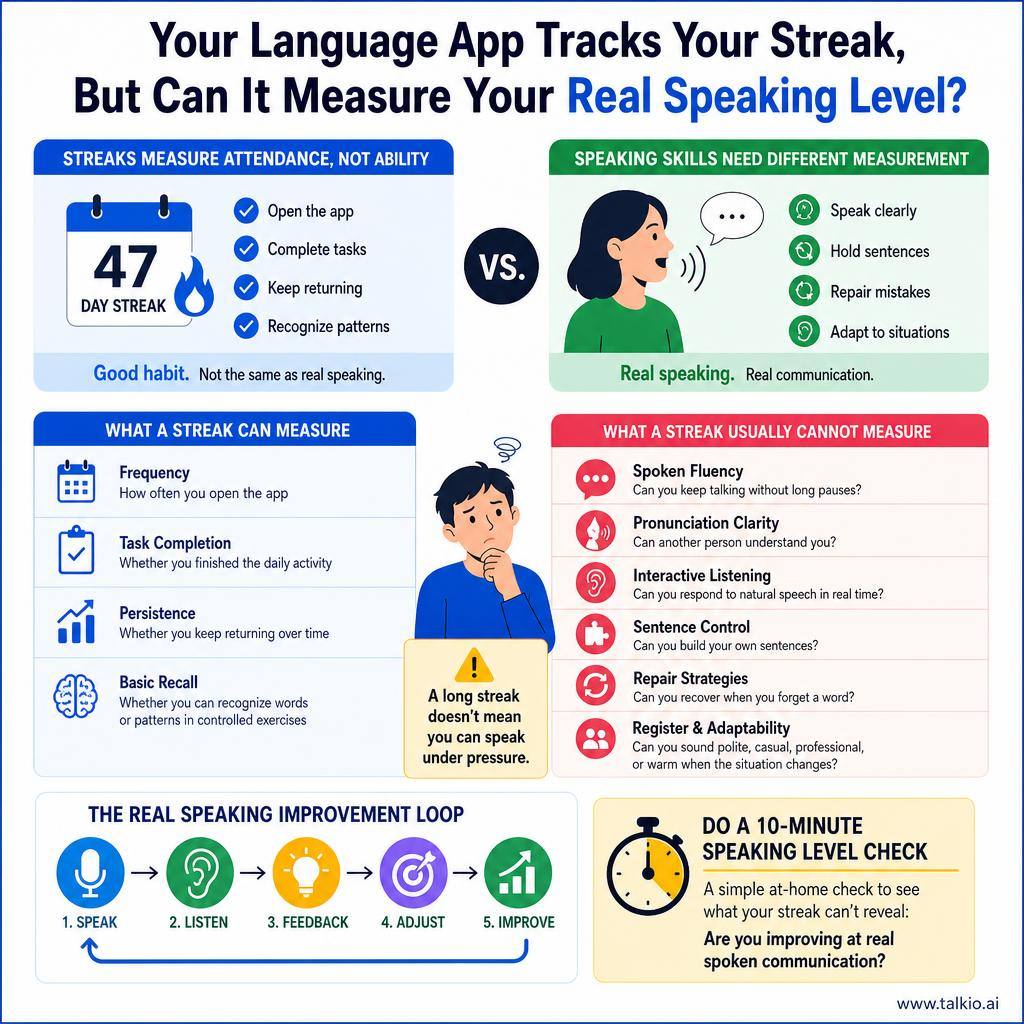
For many learners, the answer is no. A streak measures attendance. It does not measure whether your pronunciation is understandable, whether your sentences hold together under pressure, or whether you can repair a conversation when you make a mistake. Those are speaking skills, and they need a different kind of measurement.
Near the end of this article, you will find a simple 10-minute speaking level check you can run at home. It is not a formal exam, but it will reveal something your streak usually hides: whether you are improving at real spoken communication or just getting better at the app.
Why streaks feel so satisfying but tell you so little
Streaks work because they are visible, simple, and emotionally sticky. They answer one question very well: Did you show up?
That matters. Consistency is a real part of language learning. If a streak helps you build a habit, it is not useless. The problem starts when learners confuse a streak with a level.
What a streak can measure
- Frequency: how often you open the app.
- Task completion: whether you finished the daily activity.
- Persistence: whether you keep returning over time.
- Basic recall: whether you can recognize words or patterns in controlled exercises.
What a streak usually cannot measure
- Spoken fluency: can you keep talking without long, repeated pauses?
- Pronunciation clarity: can another person understand you without guessing?
- Interactive listening: can you respond to natural speech in real time?
- Sentence control: can you build your own sentences instead of selecting from options?
- Repair strategies: can you recover when you forget a word?
- Register: can you sound polite, casual, professional, or warm when the situation changes?
This is why someone can have a 300-day streak and still panic when a waiter asks a follow-up question. The learner has trained recognition. The situation demands production.
If this sounds familiar, it connects closely to the “speaking gap” many remote learners face: they study a lot, but speak very little. Talkio has covered that problem in detail in why most remote language learners don’t talk enough.
The real speaking level test: what should actually be measured?
Speaking level is not one skill. It is a bundle of smaller skills happening at the same time. That is why real conversation feels so much harder than a vocabulary quiz.
A useful speaking assessment should look at at least five areas.
1. Pronunciation: Are your sounds clear enough?
You do not need to erase your accent. But you do need to be understood. Pronunciation measurement should focus on clarity, stress, rhythm, and problem sounds.
For example, an English learner might need feedback on:
- Vowel contrast: “ship” vs. “sheep”
- Final consonants: “walked,” “asked,” “changed”
- Word stress: “PHOtograph” vs. “phoTOgraphy”
- Connected speech: “What are you going to do?” becoming “Whaddaya gonna do?”
For a deeper look at why detailed pronunciation feedback matters, see Talkio’s guide on how detailed feedback accelerates speaking skills.
2. Fluency: Can you keep the conversation moving?
Fluency is not the same as speed. A fast speaker can still be unclear. A fluent speaker can pause naturally, use filler phrases, and continue without collapsing.
Useful fluency markers include:
- How long you can speak before stopping completely
- How often you repeat the same phrase while searching for words
- Whether your pauses happen in natural places
- Whether you can continue after a correction or misunderstanding
3. Grammar in motion: Can you use structures while thinking?
Grammar quizzes measure whether you can identify the correct answer. Speaking measures whether you can use grammar while also listening, planning, pronouncing, and reacting.
Compare these two tasks:
| Quiz task | Speaking task |
|---|---|
| Choose: “I have lived / I lived here since 2020.” | Explain how long you have lived in your city and why you moved there. |
| Fill in: “If I ___ rich, I would travel.” | Discuss what you would change about your life if money were not a problem. |
| Select the correct preposition. | Give directions to your office using landmarks and time estimates. |
This is also why grammar-only learning can create a false sense of progress. If you want a practical route from rules to real usage, Talkio’s article on what actually improves English grammar skills is worth reading.
4. Listening under pressure: Can you understand and respond?
Speaking level includes listening because conversation is not a speech recording. You must process what someone says and respond quickly enough to keep the exchange alive.
Research on second-language learning often distinguishes between knowledge about a language and the ability to use it in real time. You can explore language-learning research through databases such as ERIC and academic indexes like Google Scholar.
5. Conversation management: Can you survive the messy parts?
This is the skill many apps ignore. Real speakers ask for clarification, rephrase, stall politely, check understanding, and admit uncertainty.
Try these repair phrases:
- “Sorry, could you say that another way?”
- “I know the idea, but I forgot the word.”
- “Let me start again.”
- “Do you mean today or next week?”
- “I’m not sure I understood the last part.”

The CEFR problem: levels are useful, but speaking is slippery
Many learners use labels like A2, B1, B2, or C1 to describe their level. These come from the Common European Framework of Reference for Languages, commonly known as the CEFR. It is one of the most widely used systems for describing language ability, and institutions such as Cambridge English use research-backed approaches to connect exams and language levels.
But there is a catch: learners often say “I am B1” when they really mean “my reading exercises feel B1.” Speaking may be lower, higher, or uneven.
Why your speaking level may not match your app level
- Apps often scaffold heavily: they give hints, word banks, translations, and controlled prompts.
- Speaking requires recall without a menu: you must produce language from memory.
- Conversation is unpredictable: people interrupt, ask follow-ups, and change topics.
- Pronunciation is physical: your mouth needs training, not just your memory.
- Anxiety changes performance: a learner who knows the answer may still freeze out loud.
This mismatch explains the classic intermediate frustration: you “know” enough language, but your speaking stops improving. Talkio’s article on why intermediate learners hit a fluency plateau goes further into that loop.
What good AI speaking assessment should do differently
An AI language tool should not only ask, “Did you complete today’s lesson?” It should help answer, “What changed in your speech?”
Good measurement is specific
“Good job!” is encouragement, not assessment. Useful feedback names the issue.
- Instead of: “Your pronunciation needs work.”
- Better: “Your final /t/ sound disappeared in ‘first’ and ‘last.’ Try closing the word more clearly.”
- Instead of: “Improve fluency.”
- Better: “You paused six times in a 45-second answer, mostly before verbs. Practice verb phrases for this topic.”
Good measurement happens during real production
If you only measure controlled answers, you miss the real problem. A learner may repeat “I would like a table for two” perfectly, then fail when asked, “Inside or outside?”
That is why role-play matters. A restaurant scenario, job interview, hotel check-in, classroom discussion, or business meeting forces the learner to use language under realistic pressure. For travel-specific practice, Talkio’s guide to hotel English roleplay with AI shows how scenario practice can expose gaps before they become embarrassing.
Good measurement tracks patterns over time
A single speaking sample can be noisy. Maybe you were tired. Maybe the topic was unfamiliar. Better assessment looks for repeated patterns:
- Do you always lose verb tense when telling stories?
- Do you avoid complex sentences?
- Do listeners struggle with the same three sounds?
- Do you speak more smoothly about work than about personal topics?
- Do you improve after targeted practice?
This is where AI conversation tools can be useful when designed for speaking rather than tapping. Talkio, for example, focuses on real-time voice interaction, instant feedback, structured lessons, and role-play scenarios, so learners can practice the actual behavior they want to improve: speaking.
A quick comparison: streak metrics vs. speaking metrics
If your app dashboard is full of points, gems, badges, and streaks, ask what those numbers actually prove. Here is a practical comparison.
| Metric | What it tells you | What it does not tell you |
|---|---|---|
| Daily streak | You opened the app consistently | Whether you can hold a conversation |
| XP or points | You completed many tasks | Whether the tasks were difficult or useful |
| Vocabulary count | You have seen or reviewed many words | Whether you can use them spontaneously |
| Quiz accuracy | You can recognize correct answers | Whether you can produce language without options |
| Speech feedback | Your spoken performance on pronunciation, fluency, and structure | Everything, if it is based on only one short sample |
| Scenario performance | How you handle realistic situations | Your full language level outside those contexts |
The point is not that streaks are bad. The point is that they are incomplete. A runner would not judge fitness only by counting how many days they wore running shoes. Language learners should not judge speaking ability only by counting days in an app.
The 10-minute speaking level check your streak cannot fake
Here is the promised reveal: a simple speaking check you can do today. Use your phone recorder, an AI tutor, or a voice-based language platform. The goal is not to grade yourself perfectly. The goal is to collect evidence.
Step-by-step speaking check
- Choose one everyday topic. Pick something normal: your weekend, your job, your city, a movie, your commute, or a meal you cooked.
- Speak for 60 seconds without notes. Do not restart. Do not script. Keep going even if you make mistakes.
- Answer three follow-up questions. Ask an AI tutor or a study partner to interrupt with natural questions.
- Retell the same answer in the past tense. For example, change “I usually go…” to “Last Saturday I went…”
- Explain an opinion for 45 seconds. Use a prompt like “Do you prefer working from home or in an office?”
- Listen to the recording once. Do not judge your accent emotionally. Listen for evidence.
- Score five categories from 1 to 5. Pronunciation clarity, fluency, grammar control, vocabulary range, and interaction.
Use this scoring guide
| Score | What it sounds like |
|---|---|
| 1 | You can say isolated words or memorized phrases, but conversation breaks quickly. |
| 2 | You can answer simple questions, but pauses and missing words often stop you. |
| 3 | You can explain familiar topics, but grammar and word choice become unstable under pressure. |
| 4 | You can speak smoothly about many topics, repair mistakes, and handle follow-ups. |
| 5 | You can adapt tone, explain nuance, and speak clearly even when the topic is less predictable. |
Mini prompts you can use right now
- “Describe your morning routine, then explain what was different yesterday.”
- “Tell me about a place you like. Why should someone visit it?”
- “Explain a problem at work or school and how you solved it.”
- “Compare two cities, two jobs, two meals, or two apps.”
- “Tell a story about a time you were late, surprised, or nervous.”
- “Give advice to someone visiting your country for the first time.”
If you want to practice alone before talking to a person, Talkio’s article on AI speaking warm-ups for solo learners offers a useful routine.
How schools and companies should measure speaking progress
For individual learners, a streak can be motivating. For schools and companies, it can be misleading. If an organization invests in language training, it needs to know whether people can actually communicate better.
What teachers should look for
- Before-and-after speaking samples: short recordings on comparable topics.
- Rubrics: clear scoring for pronunciation, fluency, vocabulary, grammar, and interaction.
- Task-based performance: role-plays, presentations, interviews, and group discussions.
- Student confidence: whether learners participate more often and avoid fewer speaking tasks.
The British Council publishes research and insight on English language teaching and assessment, which can be a useful reference point for educators designing speaking evaluation. See the British Council research and insight section for broader context.
What companies should look for
- Meeting readiness: can employees explain updates and ask questions?
- Client communication: can they clarify needs and respond politely?
- Presentation ability: can they structure a short spoken explanation?
- Confidence in high-stakes moments: can they speak when the pressure rises?
This is why workplace language training is shifting toward spoken performance, not just course completion. Talkio discusses this trend in the role of AI language apps in professional skill development and in its guide to AI language training for teams.
What to do if your streak is high but your speaking feels low
First, do not throw away your streak. Use it. A daily habit is valuable. Just change what the habit contains.
Replace 10 minutes of tapping with 10 minutes of talking
Try this weekly speaking routine:
- Monday: 5 minutes pronunciation practice, 5 minutes short answers.
- Tuesday: one role-play: café, meeting, appointment, interview, or travel problem.
- Wednesday: retell a story in past, present, and future forms.
- Thursday: listen to a short audio clip and summarize it out loud.
- Friday: record a 90-second opinion and review your fluency.
- Saturday: repeat the same task from Monday and compare performance.
- Sunday: choose one recurring mistake and build next week around it.
Track evidence, not ego
Instead of asking, “Am I fluent yet?” ask better questions:
- Can I speak 30 seconds longer than last month?
- Do I pause less when giving opinions?
- Are my problem sounds easier to understand?
- Can I answer follow-up questions without switching languages?
- Can I use new vocabulary in my own sentences?
For learners who feel nervous when speaking, this matters even more. Anxiety can hide ability, and repeated low-pressure conversation practice can help. Talkio’s article on AI conversation partners and speaking anxiety explains why private practice can change how learners feel when they speak.
Use your streak as a trigger, not a trophy
The best version of a streak is not “I protected my number.” It is “I used today’s session to produce language.”
So the next time your app celebrates another day completed, ask one extra question before you close it:
What did I say out loud today that I could not say last week?
If you have an answer, your streak is doing something useful. If you do not, the number may still be growing while your speaking level stands still.